
WHAT YOU NEED TO KNOW
Thank you for submitting your locate request to Indiana 811. What’s next? The following information will be helpful to you.
- Make sure the locate technicians have access to the proposed excavation area and that there are no animals present at the site.
- You are responsible for having private lines marked on your property. These are owned and maintained by the property owner, not the utility company.
Examples include:
- Propane lines from storage tanks
- Electric or water lines to pools
- Septic system lines
- Electric lines to sheds or detached structures
- Landscape lighting wiring
- Lawn sprinkler systems and more
Find out more information about private locating.
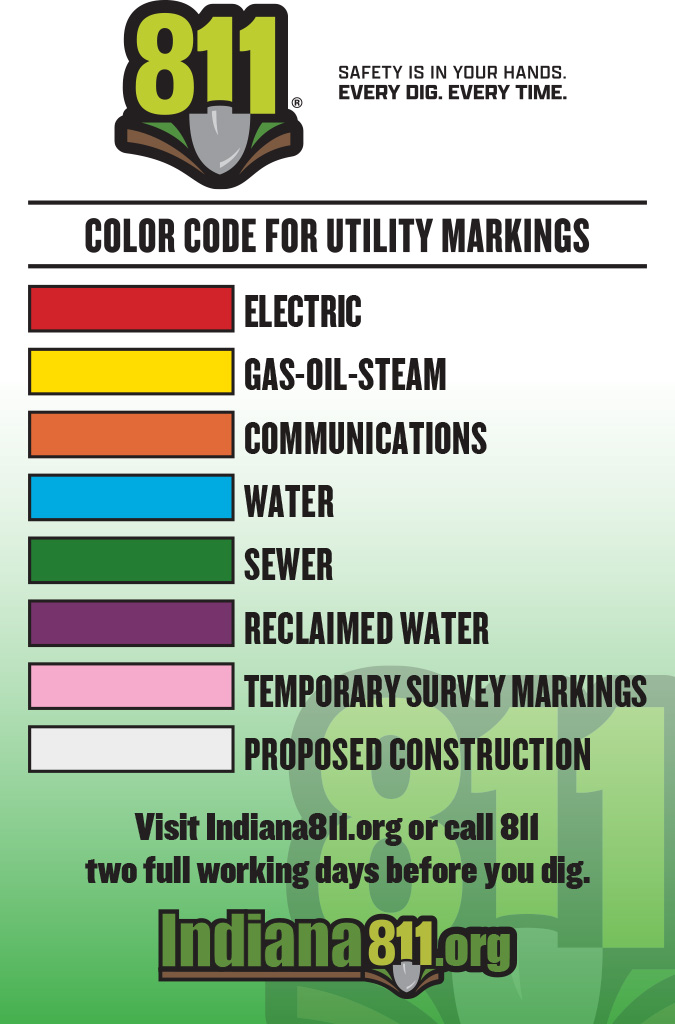
- If facility locates are required, the member utilities shall respond by marking their lines at the proposed excavation area in the color code representing their facility.
- Before starting work, Indiana law requires you to check Indiana 811’s Positive Response system to confirm all utilities have responded with a closed code. Once responses are viewed, that information is automatically logged within the system.
To check responses:
- With an Exactix account: Log in and view the Responses tab on your ticket
- Without an account: Enter your ticket number and phone number in the online tool to view ticket details and responses
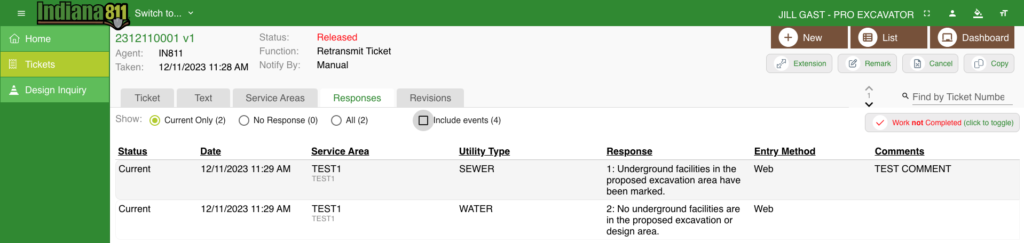
If applicable, process an additional notice online or contact Indiana. 811 at 811/800-382-5544 after viewing the responses if:
- There is no response listed by the requested start date and time.
- The response indicates that the markings are not complete by the requested start date and time.
- You have questions concerning the response provided
- Learn more about positive response.
After-hours calls to Indiana 811 will be limited to Damage and Emergency tickets. All other ticket types will only be processed during our normal operating hours, which are Monday through Friday, 7:00am-6:00pm ET. For more information, please see our Hours and Holidays.
Once all members have responded with a closed response code, you can begin digging with care.
- The law mandates a two-foot tolerance zone on either side of the marks.
- This includes all outer limits of the underground facility—above, below, and in a full radius surrounding it.
- Within the tolerance zone, only certain types of excavation are allowed, such as digging with hand tools.
- The size of the tolerance zone depends on the size of the underground facility and may be noted by utility locating technicians.
Example:
- If a water line is marked as six inches wide, the tolerance zone extends two feet three inches from the mark on all sides.
- Mechanical equipment is only to be used outside the tolerance zone.
- When working within the tolerance zone, expose the line(s) using safe, soft digging techniques, such as hand digging.

- Indiana 811 supports damage prevention by offering free, CGA-developed training for anyone planning to dig. Browse the available training.
- The original ticket shall remain valid until 11:59 p.m. ET on the expiration date if the markings are not disturbed, damaged, or no longer visible.
Update your ticket online if one of the following applies:
- The digging will not be completed by that date
- The markings have become illegible or are no longer visible
- The work location has changed
How to Update:
- If you have a Pro account, use Copy to update an existing ticket.
– If you do not have a Pro account and frequently use the system, you can upgrade by registering here to take the self-guided training course. - A Copy ticket creates a new ticket and lets you change any field.
– You can update locate instructions and remove areas where work is complete to help locators. Be sure to update the map if needed. - Attachments do not carry over to a Copy ticket. Please remember to reattach any needed files.
– Only tickets created online can include file attachments.
Interested in submitting your locate requests online?
Key benefits:
- Create a ticket in under 2 minutes
- Upload attachments (photos, plans, etc.)
- Use satellite/aerial view maps to pinpoint your dig site
- Submit, update, or additional notice tickets and check positive responses 24/7
Calling all PRO Excavators! Get involved in your local damage prevention community by attending a Damage Prevention Council (DPC) meeting.
- Connect with others in the industry
- Stay informed on safety best practices
- Participate in local damage prevention efforts
We have three councils across the state — view meeting dates and times near you on our DPC page.